The first signs of a communication failure are rarely technical.
A network may still be operational. Email systems may still be functioning. Emergency channels may still exist on paper.
Yet critical information stops moving.
Decision-makers wait for updates that never arrive. Operational teams receive conflicting instructions. Public statements are delayed because approval authority is unclear. Stakeholders begin filling information gaps with assumptions.
In many incidents, communication continuity fails long before communication infrastructure collapses.
This distinction matters.
Organizations frequently invest in technology redundancy while underinvesting in communication governance, escalation structures, recovery procedures, and decision frameworks. As a result, systems survive disruptions while communication processes do not.
A Communication Continuity Framework exists to address that gap.
Rather than focusing solely on technology, it examines how communication capabilities remain functional before, during, and after disruptive events.
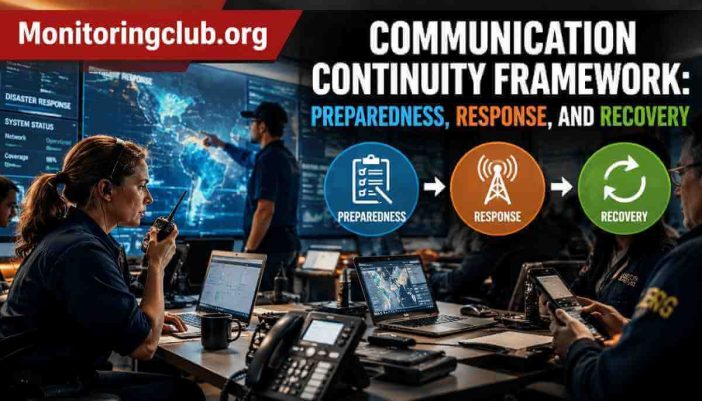
Preparedness creates readiness.
Response preserves coordination.
Recovery restores capability while strengthening future resilience.
Together, these elements form the foundation of sustainable communication continuity.
Why Communication Continuity Matters More Than Ever
Communication is often categorized as a support function.
In reality, communication serves as operational infrastructure.
Without reliable communication:
- incident response slows
- decision quality declines
- stakeholder trust deteriorates
- recovery timelines expand
- governance controls weaken
This is particularly evident in environments involving:
- critical infrastructure
- emergency management
- transportation systems
- healthcare networks
- utilities
- public safety organizations
- regulated enterprises
The question is no longer whether communication disruptions will occur.
The question is whether organizations can continue communicating effectively when disruption becomes unavoidable.
Within the broader Business Continuity, Incident Response & Emergency Communications hub, communication continuity represents the operational layer that connects preparedness planning with real-world incident management.
What Is a Communication Continuity Framework?
A Communication Continuity Framework is a structured model that ensures communication capabilities remain operational throughout disruption, response, and recovery activities.
It defines:
- communication priorities
- authority structures
- escalation paths
- redundancy mechanisms
- recovery procedures
- accountability requirements
Unlike traditional communication plans, a continuity framework focuses on sustaining communication capability under adverse conditions.
It answers practical questions such as:
- What happens if primary communication channels fail?
- Who communicates during an incident?
- Which stakeholders receive priority updates?
- How are communication decisions documented?
- How is communication capability restored after disruption?
The framework transforms communication from a reactive activity into a resilient operational function.
The Three Phases of Communication Continuity
Most successful continuity programs operate through three interconnected phases:
Preparedness
Activities conducted before disruption occurs.
Response
Actions performed during active incidents.
Recovery
Processes used to restore and improve communication capability afterward.
Organizations frequently focus on response while neglecting preparedness and recovery.
This imbalance creates recurring vulnerabilities.
Communication continuity becomes sustainable only when all three phases reinforce one another.
Phase One: Preparedness
Preparedness is where continuity is either built—or lost.
Organizations that perform well during incidents typically invested significant effort before those incidents occurred.
Communication Risk Identification
Preparation begins with understanding how communication can fail.
Common risks include:
- loss of communication infrastructure
- authority confusion
- misinformation
- staff unavailability
- vendor dependency failures
- regulatory disclosure delays
This analysis aligns closely with concepts discussed in Risk Management in Communication Systems, where communication risks are evaluated as operational exposures rather than isolated technical problems.
Organizations that fail to identify communication risks rarely manage them effectively.
Stakeholder Communication Mapping
Not all audiences have equal communication requirements.
Preparedness requires identifying:
- internal leadership
- operational personnel
- customers
- regulators
- media organizations
- public stakeholders
- partner organizations
Each stakeholder group may require:
- different channels
- different timing
- different approval requirements
- different escalation thresholds
Without stakeholder mapping, communication efforts become fragmented during emergencies.
Authority and Escalation Design
Many communication failures stem from uncertainty rather than technical outages.
Preparedness requires clearly defining:
- who can approve messages
- who can activate emergency communication procedures
- who can escalate incidents
- who can communicate externally
These governance requirements intersect with principles explored within the Communication Governance Framework: Risk, Compliance, and Accountability.
Authority ambiguity during emergencies often causes greater damage than infrastructure failures.
Channel Redundancy Planning
Communication continuity depends on redundancy.
Organizations should identify:
Primary Channels:
- corporate email
- collaboration platforms
- operational systems
Secondary Channels:
- SMS alerts
- emergency notification platforms
- alternative communication networks
Contingency Channels:
- satellite communications
- radio systems
- manual notification procedures
- emergency contact trees
The objective is not simply having multiple channels.
The objective is ensuring communication remains possible when primary systems become unavailable.
Communication Exercises and Testing
Plans that are never tested become assumptions.
Preparedness should include:
- tabletop exercises
- continuity simulations
- incident communication drills
- stakeholder notification tests
- escalation verification exercises
Testing reveals weaknesses before incidents expose them publicly.
Original Value Framework: The Communication Continuity Readiness Model
Organizations can assess preparedness using five readiness indicators.
| Area | Question |
|---|---|
| Authority | Is communication authority clearly documented? |
| Risk | Have communication failure scenarios been identified? |
| Redundancy | Are alternative channels available and tested? |
| Accountability | Are decisions traceable and reviewable? |
| Recovery | Is communication restoration planned and documented? |
Weakness in any area increases continuity risk significantly.
This model can serve as an annual governance review checklist.
Phase Two: Response
Preparedness creates potential.
Response determines whether that potential becomes operational reality.
During incidents, communication continuity faces its greatest test.
The challenge is not simply transmitting information.
The challenge is transmitting the right information to the right stakeholders at the right time under conditions of uncertainty.
Communication Objectives During Response
Response communications generally serve four objectives:
- Establish situational awareness.
- Coordinate operational activity.
- Maintain stakeholder confidence.
- Support decision-making.
Organizations that pursue all four simultaneously tend to perform better than those focusing solely on public messaging.
The First Operational Hour
Many incident investigations reveal that communication outcomes are heavily influenced by the first hour.
Critical actions include:
- activating communication governance structures
- assigning authority
- validating information sources
- establishing communication frequency
- documenting key decisions
The goal is controlled communication rather than immediate communication.
Speed without governance often creates secondary problems.
Maintaining Information Integrity
During disruptions, information quality frequently deteriorates.
Common causes include:
- incomplete information
- unofficial updates
- duplicate reporting
- unverified assumptions
- competing narratives
Communication continuity depends on protecting information integrity while uncertainty remains high.
This often requires disciplined validation processes rather than rapid publication cycles.
Operational Coordination Under Stress
Communication continuity is ultimately an operational discipline.
Teams must coordinate:
- incident response personnel
- executives
- legal advisors
- compliance functions
- technical specialists
- external stakeholders
When communication systems become overloaded, coordination structures become more important than technology itself.
The strongest continuity programs recognize this reality early.
Response Phase Continued: Communication Continuity Under Active Disruption
Managing Stakeholder Expectations
One of the most overlooked aspects of communication continuity is expectation management.
Stakeholders do not always expect certainty during an incident.
They do expect:
- transparency
- consistency
- reasonable update frequency
- visible leadership
Organizations often damage trust by remaining silent until complete information becomes available.
A continuity-oriented approach acknowledges uncertainty while maintaining communication discipline.
Messages should explain:
- what is known
- what is being verified
- when further updates will occur
This approach preserves credibility while supporting operational stability.
Documentation During Response
Communication continuity also requires documentation.
Critical records include:
- major communication decisions
- approval actions
- escalation events
- stakeholder notifications
- corrective communications
These records become essential during:
- investigations
- audits
- compliance reviews
- post-incident assessments
Organizations that fail to document decisions often struggle to explain them later.
This accountability principle aligns closely with Communication Audit Trails: How Accountability Is Proven, Not Claimed.
Phase Three: Recovery
Recovery begins before an incident officially ends.
Many organizations view recovery as a technical activity.
Communication continuity requires a broader perspective.
Recovery focuses on restoring communication capability, rebuilding confidence, and strengthening resilience for future disruptions.
Restoring Communication Capability
Recovery activities typically include:
- restoration of primary communication channels
- validation of communication workflows
- stakeholder notification regarding service restoration
- re-establishment of governance controls
The objective is not merely returning systems to operation.
The objective is restoring trusted communication capability.
Reviewing Communication Performance
Every disruption creates learning opportunities.
Recovery should include structured evaluation of:
- communication effectiveness
- governance performance
- escalation efficiency
- stakeholder response
- information accuracy
Organizations that fail to review communication performance often repeat identical failures.
Identifying Governance Weaknesses
Recovery frequently reveals weaknesses that remained hidden during normal operations.
Common findings include:
- unclear authority structures
- redundant approval processes
- inadequate stakeholder mapping
- insufficient documentation practices
- ineffective escalation triggers
Addressing these weaknesses strengthens future continuity performance.
Updating Communication Risk Registers
Recovery findings should feed directly into communication risk management.
New risks identified during incidents should be added to:
- communication risk registers
- continuity plans
- governance frameworks
- incident response procedures
This creates a continuous improvement cycle.
Organizations mature when lessons become documented controls.
Institutional Learning and Resilience
The strongest organizations do not aim to eliminate disruption.
They aim to learn faster from disruption.
Communication continuity becomes resilient when:
- incidents generate insight
- reviews produce improvements
- improvements become operational practice
This is where continuity evolves from preparedness into organizational capability.
Expert Insight: Continuity Is a Governance Discipline
Expert Insight
Many organizations treat communication continuity as a technology problem.
In reality, most continuity failures originate from governance weaknesses.
Communication systems usually fail because:
- authority is unclear
- escalation paths are undefined
- accountability is weak
- recovery planning is incomplete
Technology supports continuity.
Governance enables continuity.
The distinction becomes visible during every major disruption.
Practical Tips for Building Communication Continuity
Start With Authority Mapping
Define who can communicate during:
- routine operations
- elevated incidents
- major emergencies
Authority confusion is one of the most common continuity failures.
Build Redundancy Beyond Technology
Redundancy should include:
- personnel
- procedures
- approval structures
- communication channels
Technology alone cannot ensure continuity.
Test Continuity Regularly
Conduct:
- tabletop exercises
- scenario workshops
- emergency communication drills
Testing reveals assumptions before incidents expose them publicly.
Document Decisions Consistently
Organizations should maintain:
- communication logs
- approval records
- escalation documentation
Documentation strengthens accountability and recovery.
Learn From Every Incident
Every disruption should improve:
- governance
- risk management
- continuity planning
- communication resilience
Continuity is not a static capability.
It is an evolving discipline.
How Communication Continuity Connects to the Broader Framework
Communication continuity sits at the intersection of:
- governance
- risk management
- incident response
- business continuity
- organizational resilience
Preparedness creates readiness.
Response sustains operations.
Recovery builds resilience.
Together, they create a sustainable communication capability capable of functioning during uncertainty, disruption, and crisis.
This framework also complements:
- Communication Governance Framework: Risk, Compliance, and Accountability
- Risk Management in Communication Systems
- Compliance by Design in Communication Infrastructure
- Accountability Models for Institutional Communications
Collectively, these frameworks form a system-level approach to communication resilience.
FAQ – People Also Ask
What is a communication continuity framework?
A communication continuity framework is a structured model that ensures communication capabilities remain operational before, during, and after disruptive events.
Why is communication continuity important?
Because communication enables coordination, decision-making, stakeholder trust, and operational effectiveness during disruptions.
How does communication continuity differ from crisis communication?
Crisis communication focuses on messaging during incidents, while communication continuity focuses on maintaining communication capability across preparedness, response, and recovery phases.
Who is responsible for communication continuity?
Responsibility is typically shared among communication leaders, continuity planners, risk managers, executives, and operational teams through defined governance structures.
How often should communication continuity plans be tested?
At minimum annually, with additional testing following major organizational changes, technology upgrades, or significant incidents.
Wrapping Up: Communication Continuity as an Organizational Capability
Disruptions are inevitable.
Communication failure is not.
Organizations that invest in communication continuity frameworks create structures capable of maintaining clarity, coordination, and trust when uncertainty is highest.
Preparedness creates the foundation.
Response preserves operational effectiveness.
Recovery transforms disruption into resilience.
The institutions that communicate best during crises are rarely the fastest.
They are the most prepared.
Reference
- International Organization for Standardization (ISO 22301 Business Continuity Management)
- National Institute of Standards and Technology (NIST Incident Response and Resilience Guidance)
- Federal Emergency Management Agency (FEMA Emergency Communications Guidance)
This article follows MonitoringClub.org’s Editorial Policy and supports long-term analysis within the Business Continuity, Incident Response & Emergency Communications authority hub.