
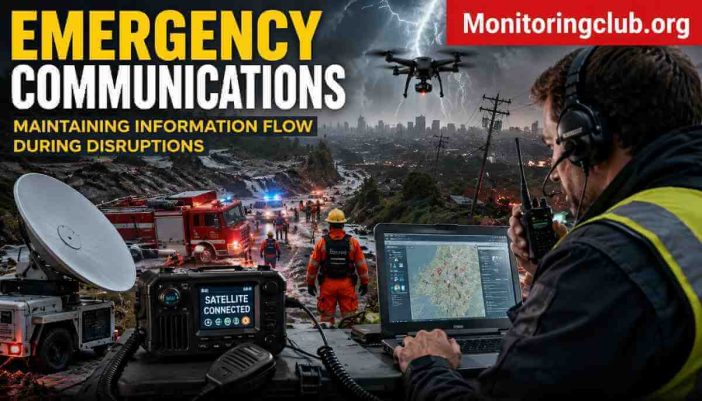
Wildfires cut power across several counties.
Floodwaters isolate transportation corridors.
A cyberattack disables internal email services.
A satellite link unexpectedly drops offline.
These events appear unrelated, yet they expose the same vulnerability: organizations depend heavily on communication systems that were never designed to operate under adverse conditions.
During disruptions, information can become as important as electricity, fuel, or physical access. Decision-makers require updates. Emergency responders need coordination. Communities expect instructions.
When communication channels collapse, uncertainty spreads faster than the original incident.
Emergency communications systems exist to reduce that uncertainty and preserve the movement of critical information when conventional methods fail.
What Emergency Communications Systems Actually Do
Emergency communications systems are designed to maintain the availability, integrity, and accessibility of information during disruptive events.
Their purpose extends beyond broadcasting alerts.
They help organizations continue operating when normal communication pathways become degraded, overloaded, or completely unavailable.
Typical functions include:
- distributing emergency notifications
- supporting operational coordination
- connecting dispersed response teams
- maintaining executive situational awareness
- preserving communication continuity for external stakeholders
Within the broader Communication Continuity Framework: Preparedness, Response, and Recovery, emergency communication capabilities serve as one of the most visible indicators of organizational resilience.
Why Traditional Communication Channels Often Fail
Many organizations assume internet connectivity alone guarantees communication continuity.
Experience suggests otherwise.
Infrastructure Dependencies
Modern communication platforms frequently depend upon:
- commercial power
- internet providers
- centralized cloud services
- cellular networks
- local network equipment
Failure of any component may affect the entire communication chain.
Congestion During Emergencies
Communication demand typically increases during crises.
Voice networks may become saturated.
Messaging applications can experience delays.
Email delivery queues may slow dramatically.
Systems built for convenience often struggle under abnormal loads.
Single Points of Failure
Organizations sometimes rely on one preferred communication platform.
This creates hidden fragility.
When the primary channel becomes unavailable, teams may have no tested alternatives.
Components of Effective Emergency Communications Systems
Multiple Communication Paths
Resilient communication environments rarely depend on a single technology.
Examples include:
Primary Systems
- VoIP
Secondary Systems
- SMS alerts
- secure messaging applications
Tertiary Systems
- satellite terminals
- VHF/UHF radio
- HF radio networks
Fallback Systems
- paper procedures
- physical runners
- predetermined meeting points
The objective is not redundancy for its own sake.
It is maintaining at least one functioning information pathway.
Emergency Notification Capabilities
Mass notification tools help organizations deliver messages simultaneously across several platforms.
Notifications may include:
- evacuation instructions
- shelter guidance
- operational updates
- executive alerts
- employee accountability requests
Emergency Operations Center Integration
Emergency communication systems work best when integrated into Emergency Operations Centers (EOCs).
This integration enables:
- shared situational awareness
- coordinated messaging
- resource prioritization
- decision synchronization
Original Value Framework
The Communication Survivability Pyramid
| Layer | Objective |
|---|---|
| Layer 1 | Preserve executive decision-making |
| Layer 2 | Maintain responder coordination |
| Layer 3 | Inform employees and partners |
| Layer 4 | Support public information activities |
| Layer 5 | Archive communication records |
Organizations frequently focus on Layer 4 while neglecting Layers 1 and 2.
However, if internal coordination fails, public messaging becomes unreliable.
Communication Redundancy Is Not Duplication
A common misconception is that redundancy simply means purchasing more equipment.
Effective redundancy requires diversity.
For example:
Poor redundancy
Email server A
Email server B
Good redundancy
SMS
Satellite
Radio
Paper contingency procedures
Different technologies fail for different reasons.
Diversity reduces shared vulnerabilities.
Small Scenario
Imagine a regional utility company experiencing a ransomware attack.
Without emergency communication systems:
Corporate email unavailable
Executives cannot contact field teams
Customer service receives inconsistent information
Public statements delayed
With emergency communication systems:
Satellite phones activated
SMS alert groups operational
Field supervisors report status through radio channels
Pre-approved notification templates distributed
The technical problem remains difficult.
But operational coordination survives.
Expert Insight
Organizations often purchase emergency communication technologies before understanding how information should flow during disruption.
Technology rarely compensates for unclear authority, undefined escalation paths, or missing continuity procedures.
Systems become significantly more effective when communication governance is established before platforms are selected.
Practical Checklist
Before selecting emergency communication technologies, ask:
Can leadership communicate if internet access disappears?
Can teams coordinate if cellular networks fail?
Are backup channels tested annually?
Can communication records be preserved during outages?
Are emergency notifications approved in advance?
Can critical messages be transmitted within fifteen minutes?
Relationship With Other Communication Frameworks
Emergency communications systems do not operate independently.
They reinforce several complementary disciplines.
Communication continuity planning establishes preparedness.
Incident response communications manage information while events unfold.
Communication recovery planning restores confidence after stabilization.
Mission-critical communication systems provide specialized infrastructure for environments where communication interruptions are unacceptable.
FAQ
What is an emergency communications system?
An emergency communications system is a collection of technologies, procedures, and backup methods used to maintain information exchange during disruptive events.
Why are backup communication channels important?
Because primary communication platforms often depend on shared infrastructure that may become unavailable during disasters, cyber incidents, or large-scale outages.
Are emergency communications systems only for government agencies?
No.
Hospitals, utilities, universities, transportation providers, and private organizations also benefit from resilient communication capabilities.
Information Systems Are Tested By Failure, Not Stability
Communication systems appear reliable when conditions remain predictable.
Their true value becomes visible when assumptions disappear.
Organizations that invest in emergency communications systems are not preparing for catastrophe alone.
They are preserving the ability to coordinate, decide, and communicate when disruption attempts to remove those capabilities entirely.