
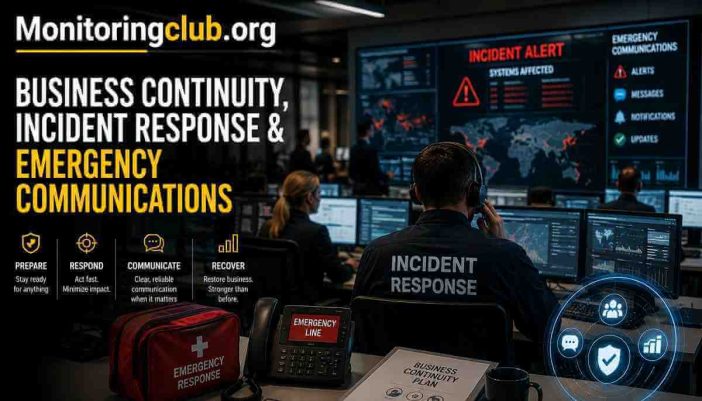
Business Continuity, Incident Response & Emergency Communications is an authority hub dedicated to understanding how organizations maintain communication, operational awareness, and decision continuity during disruption, crisis, and system failure.
This hub examines the structures, frameworks, and communication processes that allow institutions to continue functioning when normal operations are interrupted.
MonitoringClub.org approaches continuity and emergency communications as system-level disciplines that combine governance, operational resilience, communication readiness, and post-incident learning.
Why Continuity and Incident Response Matter
Disruptions rarely begin as catastrophic events.
Most crises emerge through a chain of smaller failures:
- Information delays
- Escalation breakdowns
- Communication bottlenecks
- Infrastructure disruption
- Decision uncertainty
When continuity planning is absent, these failures compound.
Business continuity and emergency communications exist to ensure organizations can continue making decisions, sharing information, and coordinating responses under pressure.
This hub focuses on the communication dimension of continuity—not merely technical recovery.
Core Focus Areas
Business Continuity Planning
How institutions prepare communication systems, governance structures, and operational processes for disruption.
Topics include:
- Communication continuity planning
- Critical information flow mapping
- Operational resilience frameworks
- Continuity governance models
Incident Response Communications
How organizations communicate during incidents, emergencies, and operational disruptions.
Topics include:
- Incident communication frameworks
- Escalation and notification models
- Stakeholder communication during disruption
- Information management under uncertainty
Emergency Communications Systems
How communication systems function when normal channels are degraded or unavailable.
Topics include:
- Emergency notification systems
- Redundant communication pathways
- Resilient communication infrastructure
- Public warning and alerting mechanisms
Operational Resilience & Recovery
How organizations restore confidence, coordination, and operational capability after disruption.
Topics include:
- Recovery communication planning
- Lessons learned and after-action reviews
- Continuity testing and exercises
- Organizational resilience development
Featured Pillar & Framework Content
Communication Continuity Framework: Preparedness, Response, and Recovery
A comprehensive framework explaining how communication continuity supports organizational resilience before, during, and after disruption.
→ Read More Communication Continuity Framework: Preparedness, Response, and Recovery
Incident Response Communication Models
Analysis of communication structures used during operational incidents and emergency response.
→ Read More Incident Response Communication Models
Emergency Communications Infrastructure and Resilience
How resilient communication systems support continuity when normal operations are compromised.
Post-Incident Learning and Organizational Improvement
Frameworks for turning operational failures into long-term resilience improvements.
These resources are designed as evergreen reference materials intended for long-term institutional value.
Relationship With Governance and Communication Risk
Continuity and incident response do not operate independently.
They rely on:
- Governance structures
- Defined decision authority
- Communication accountability
- Risk assessment processes
Organizations that lack communication governance often struggle during emergencies because authority, escalation, and accountability remain unclear.
Readers interested in these foundational elements should also explore:
- Governance, Risk & Compliance for Communications
- Communication Governance Framework: Risk, Compliance, and Accountability
Together, these domains form a complete operational resilience ecosystem.
Intended Audience
This hub is designed for:
- Business continuity professionals
- Incident response coordinators
- Emergency management practitioners
- Communication managers
- Operational resilience leaders
- Governance and risk professionals
- Researchers and analysts
It is intended for readers seeking structured, evidence-based analysis rather than real-time event coverage.
Editorial Standards & Responsibility
All content published within this hub:
- Follows MonitoringClub.org’s Editorial Policy
- Is reviewed under the Content Review & Verification Policy
- Operates within the boundaries defined by our Disclaimer & Information Responsibility
- Supports the broader Editorial Governance Framework
Content is developed using publicly accessible information, documented frameworks, and system-level analysis.
MonitoringClub.org does not provide operational emergency instructions, tactical response guidance, or crisis management consulting.
Related Authority Resources
Readers may also find value in:
- Governance, Risk & Compliance for Communications
- Communication Governance Framework: Risk, Compliance, and Accountability
- Editorial Governance Map
- Content Review & Verification Policy
These resources provide the governance and accountability foundations that support continuity and incident response systems.
This hub is part of MonitoringClub.org’s editorial governance framework, as outlined in the Editorial Governance Map, and follows our Editorial Policy and Content Review & Verification Policy. All content is provided under our Disclaimer & Information Responsibility.
Governance Knowledge Path
Start here:
- Redundancy in Communication Systems: Why Backup Channels Matter During Disruptions
- Incident Escalation Frameworks: When and How Communication Authority Changes
- Communication Recovery Planning: Restoring Trust After Operational Failures
- Emergency Communications Systems: Maintaining Information Flow During Disruptions
- Incident Response Communications: Managing Information Under Pressure
- Communication Continuity Framework for Resilience ♔
- Top Real-Time Communication Tools for Emergency Response
- Importance of Radio in Emergencies: A Lifesaving Communication Tool