The first thirty minutes of an incident often determine how the next thirty days will be remembered.
A service outage starts affecting customers.
Engineers investigate.
Support teams receive complaints.
Executives request updates.
Legal advisors ask questions.
Journalists begin contacting the organization.
At that moment, communication rarely fails because people lack information.
It fails because authority becomes uncertain.
Operational teams may understand the problem.
Senior leadership may understand the consequences.
Compliance teams may understand disclosure obligations.
Yet nobody knows who should communicate publicly, when approval requirements should change, or how decision authority should evolve as conditions worsen.
Incident escalation frameworks exist to solve this problem before pressure exposes it.
Why Communication Authority Cannot Remain Static
Organizations frequently design communication approval processes for normal operations.
Routine announcements often follow predictable workflows.
Marketing drafts messages.
Managers review them.
Executives approve them.
Publication occurs.
Incidents rarely provide enough time for these procedures.
Communication authority must adapt as conditions change.
An escalation framework provides predetermined rules for transferring authority between operational, tactical, and executive levels.
What Is an Incident Escalation Framework?
An incident escalation framework is a structured governance mechanism that determines:
who communicates,
when authority changes,
which thresholds trigger escalation,
how responsibilities shift,
what approvals remain mandatory.
Rather than relying on improvisation, escalation frameworks transform communication authority into a predictable process.
Within the broader Communication Continuity Framework: Preparedness, Response, and Recovery, escalation frameworks serve as the bridge between preparedness planning and active incident response.
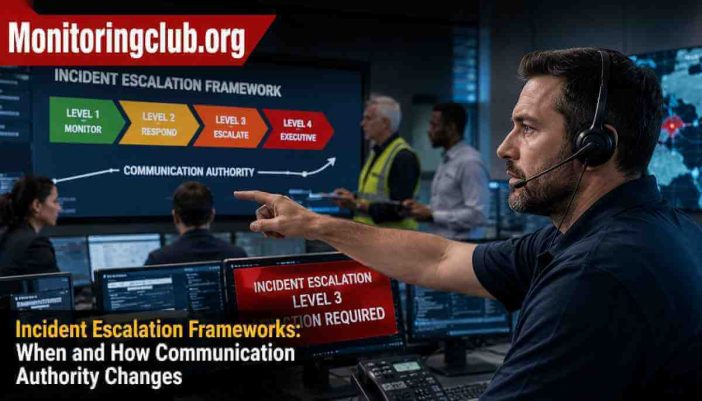
The Four Levels of Communication Escalation
Level 1 — Operational Events
Examples include:
minor service interruptions
localized technical issues
scheduled maintenance deviations
Communication responsibility generally remains with operational teams.
Characteristics
Low public visibility
Limited impact
No regulatory implications
Authority Holder
Operational supervisors
Communication coordinators
Level 2 — Significant Disruption
Examples include:
extended outages
service degradation
critical supplier failures
Communication authority typically shifts toward incident management teams.
Characteristics
Multiple stakeholders affected
Potential reputational consequences
Increasing executive awareness
Authority Holder
Incident commanders
Business continuity managers
Level 3 — Crisis Conditions
Examples include:
major cyber incidents
nationwide service disruption
public safety concerns
Communication decisions often require executive approval.
Characteristics
Regulatory scrutiny
Media attention
Public concern
Authority Holder
Executive leadership
Corporate communications directors
Level 4 — Extraordinary Events
Examples include:
national emergencies
cross-border disruptions
long-term infrastructure failures
Communication authority becomes centralized.
Characteristics
Government interaction
Legal exposure
Institutional credibility at stake
Authority Holder
Chief executives
Designated spokespersons
Emergency communication cells
Original Value Section: Communication Escalation Decision Matrix
| Severity | Communication Authority | Approval Requirement | External Disclosure |
|---|---|---|---|
| Level 1 | Operational Team | Immediate Supervisor | Usually No |
| Level 2 | Incident Management | Incident Manager | Limited |
| Level 3 | Executive Communications | Executive Approval | Yes |
| Level 4 | Crisis Leadership Team | Strategic Oversight | Mandatory |
Organizations rarely fail because escalation levels do not exist.
They fail because thresholds are vague.
What Triggers Escalation?
Escalation should never depend solely on personal judgment.
Effective organizations define measurable triggers.
Examples include:
Number of affected users
Service downtime duration
Potential regulatory exposure
Safety implications
Media inquiries
Stakeholder complaints
Data integrity concerns
Triggers reduce uncertainty and eliminate debates during stressful situations.
Escalation and Communication Governance
Escalation frameworks depend heavily upon governance maturity.
As discussed in Who Has Authority to Communicate During a Crisis? Governance Decision Models Explained, authority cannot be negotiated while an incident is unfolding.
Escalation mechanisms simply operationalize predefined authority models.
They determine:
when delegated authority ends,
when executive oversight begins,
when legal review becomes mandatory.
Escalation and Incident Response
Escalation frameworks influence communication speed more than communication skill.
Organizations that define escalation rules beforehand usually provide faster updates.
Organizations without escalation structures often experience:
approval bottlenecks
contradictory messaging
communication paralysis
These challenges are examined further in Incident Response Communications: Managing Information Under Pressure, where information management must continue despite uncertainty.
Escalation and Recovery Planning
Escalation decisions continue affecting organizations long after systems recover.
Post-incident reviews frequently identify:
unclear authority boundaries
inappropriate delegation
unnecessary approval layers
delayed stakeholder notifications
Recovery initiatives should therefore evaluate whether escalation thresholds were appropriate.
This complements Communication Recovery Planning: Restoring Trust After Operational Failures, where organizations examine how authority decisions influenced stakeholder confidence.
Common Escalation Mistakes
Escalating Too Late
Teams hesitate.
Managers seek additional confirmation.
Public speculation grows.
Escalating Too Early
Executives become overwhelmed.
Operational flexibility decreases.
Minor incidents consume strategic resources.
Undefined Thresholds
Severity classifications become subjective.
Different departments interpret incidents differently.
Confusing Hierarchy With Authority
Seniority does not automatically grant communication authority.
Governance structures should determine authority.
Expert Insight
Escalation frameworks are frequently treated as operational tools.
They are actually governance instruments.
Their primary purpose is not moving information upward.
Their purpose is ensuring communication authority changes in a predictable, reviewable, and accountable manner.
Practical Escalation Checklist
Before incidents occur, organizations should verify:
☑ Severity levels documented
☑ Escalation triggers defined
☑ Communication authority assigned
☑ Backup spokespersons identified
☑ Approval exceptions documented
☑ Executive notification procedures tested
☑ Escalation framework reviewed annually
FAQ
What is an incident escalation framework?
It is a structured model that defines how authority and communication responsibilities change as incidents become more severe.
Why are escalation frameworks important?
They reduce decision delays, prevent conflicting messages, and ensure communication authority adapts appropriately to changing circumstances.
Who should approve communication during major incidents?
Approval responsibilities should be predefined within governance structures and aligned with incident severity thresholds.
Escalation Is Ultimately About Preparedness
Incidents rarely create organizational weaknesses.
They reveal weaknesses that already existed.
An escalation framework allows institutions to respond with consistency instead of improvisation.
When communication authority changes according to predefined rules, organizations preserve clarity, maintain accountability, and improve resilience long before recovery efforts begin.