
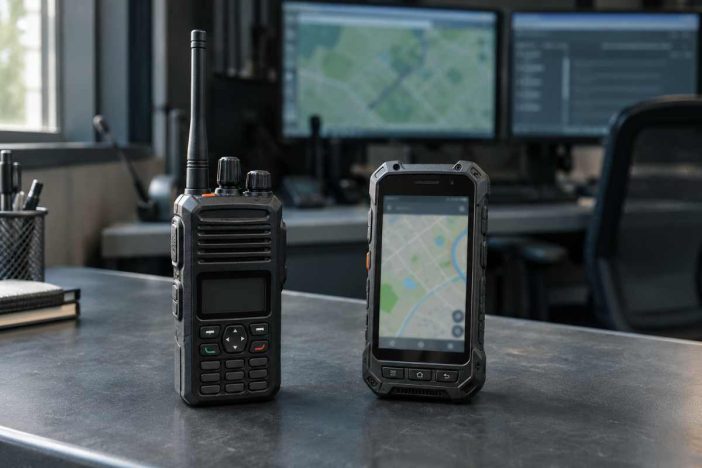
A crew enters a concrete service tunnel. At the entrance, a handheld radio reaches dispatch and a rugged phone shows the crew’s location. Farther inside, the location marker stops moving. Two workers can still hear each other on their radios, but dispatch can no longer hear either of them.
That is a hypothetical outage, but it exposes a real procurement problem: local voice, dispatch voice, and location reporting are three different services. A system can preserve one and lose the other two. Before deciding whether to keep land mobile radio (LMR), add LTE, or replace part of an existing system, decide which of those services must survive and who needs to receive them.
LMR vs LTE: Compare the Services First
Land mobile radio covers a family of two-way radio systems. For a field crew, a common use is group voice: someone presses a button, speaks, and the group hears the call. The path can be directly between radios, through a repeater that extends coverage, or through a wider network that connects sites and dispatch. Each path depends on different equipment.
LTE is a mobile broadband technology that can carry voice, location, images, video, and other data. Mission-critical push-to-talk (MCPTT) is a service that can run over a compatible broadband deployment. LTE coverage by itself does not establish that a device has MCPTT, that emergency calls are handled as required, or that an application will keep working outside network coverage.
| What the team needs | What to verify on LMR | What to verify on LTE |
|---|---|---|
| Group voice | Which radios, talkgroups, and dispatch positions can reach one another in the required operating modes? | Which devices and groups support the chosen voice service, and how are priority and emergency calls handled? |
| Voice outside normal coverage | Can crews use a supported direct mode at the locations and distances that matter? Who can hear that traffic? | Is an off-network option supported and enabled on the actual devices? Which functions remain available in that mode? |
| Location, images, or video | What data, if any, can this radio system deliver for the intended workflow? | Does the field application deliver usable data with the expected coverage, uplink capacity, and network load? |
| Communication between systems | Which radio groups and dispatch functions are available through the link? | Which call types, identities, alerts, or data cross the link in each direction? |
Use the mission-critical communications hub for the broader picture of how networks, spectrum, power, and interoperability fit together. For a wider set of backup options, the guide to real-time emergency communication tools covers alternatives beyond this radio and broadband comparison.
Three Failures to Put in the Acceptance Plan
Coverage maps and equipment specifications help you decide where to look. Acceptance testing tells you whether a specific crew can reach a specific person, at a specific location, under the conditions that matter. Use authorized test environments or planned exercises coordinated by the people responsible for the network.
| Failure scenario | What to verify | Evidence to record |
|---|---|---|
| LTE coverage is lost where a crew works | Determine whether nearby crew members can still communicate, whether anyone can reach dispatch, and whether dispatch can tell that location updates have stopped. Evaluate any supported off-network option separately from the normal LTE service. | Test location, devices and operating modes, who heard each call, and whether the dispatch display clearly showed the loss of fresh location data. |
| A radio or LTE site loses its connection to the wider network | Determine which services still work locally and which depend on a remote controller, network core, application server, or dispatch connection. Check whether a local user can reach another local user and someone outside the site. | Separate results for local voice, cross-site voice, dispatch access, and data. Record what happens when the connection is restored. |
| The LMR–LTE link stops passing calls | Verify whether each network still works independently. Check who notices the loss of cross-network traffic and whether there is an approved alternate way for the two groups to coordinate. | Results in each direction, whether dispatch received an indication of failure, and whether the alternate path reached the intended people. |
Count Local Voice and Dispatch Voice Separately
A radio-to-radio call can pass locally while dispatch remains out of reach. If the requirement is to warn a nearby partner, that local call may be enough. If the requirement is to summon help through dispatch, it is only a partial pass. Write those as separate requirements so the test cannot count one successful call as proof of both.
Trace the Dependencies Behind the Backup
Backhaul connects a site to the wider network. A handset can still show a signal from nearby equipment while the service it needs is unavailable farther along the path. Two services can also share a building, a power supply, or an upstream connection. Record which dependencies they share before treating either as a fallback. The guide to emergency communications systems explains how alternate paths fit into a broader continuity plan.
Ask What the Link Preserves
A demonstration in which a radio and a phone exchange voice is useful. The next question is whether dispatch can identify the caller, whether the required emergency indication arrives, and whether users on both sides can tell when the link is down. Test the features your team needs in both directions, with the devices and configurations it intends to use.
3GPP TS 23.283 provides a technical reference for interworking between mission-critical communications services and LMR systems. NIST’s analog LMR-to-LTE MCPTT report documents a tested proof of concept. Together, they give buyers a basis for asking how a proposed link works. Acceptance still depends on evidence from the proposed deployment.
When to Retain LMR, Add LTE, or Evaluate a Hybrid System
Retain LMR where an existing voice path meets a requirement the proposed replacement has yet to demonstrate. Examples include nearby crews speaking directly at a site with poor coverage, or dispatch reaching field units under a defined network failure. Record the specific function you are retaining and the evidence that would justify a future change.
Add LTE where a field task benefits from broadband. A crew might need to send a damage photo, see a shared map, or report its location. Evaluate whether those tasks work in the places crews actually operate, including indoors and at the edge of coverage. If LTE is also expected to carry essential group voice, assess that voice service on its own terms.
Evaluate a hybrid system when the same operation benefits from both and the teams need to communicate across networks. Include the interworking link, dispatch workflow, maintenance responsibilities, and alternate coordination path in the evaluation. When comparing bids, include recurring connectivity, device replacement, support, and periodic testing alongside the equipment price.
What to Ask for Before Signing Off
Ask the supplier and the network owner for a short acceptance record that names the users, locations, required functions, and failure conditions. Set pass criteria before the demonstration. For example: “When the interworking link is unavailable, crews on each network can still reach their own dispatch position, and both dispatchers can identify the loss of cross-network voice.” Use criteria that reflect the proposed operation.
Have the responsible communications engineer and license holder confirm the applicable spectrum, licensing, and test conditions for the deployment jurisdiction. A standard, a device specification, and permission to operate are separate matters. Keep the acceptance record with the system documentation so it can be revisited when devices, network providers, or dispatch arrangements change.
Keep the Communication Path You Can Verify
The practical decision in LMR vs LTE starts with a service that must survive: a crew warning a colleague, a dispatcher reaching a field unit, or a team sending information another person can act on. Keep the path that meets that requirement, add capabilities where they solve a field problem, and document exactly what happens when a shared dependency fails.
