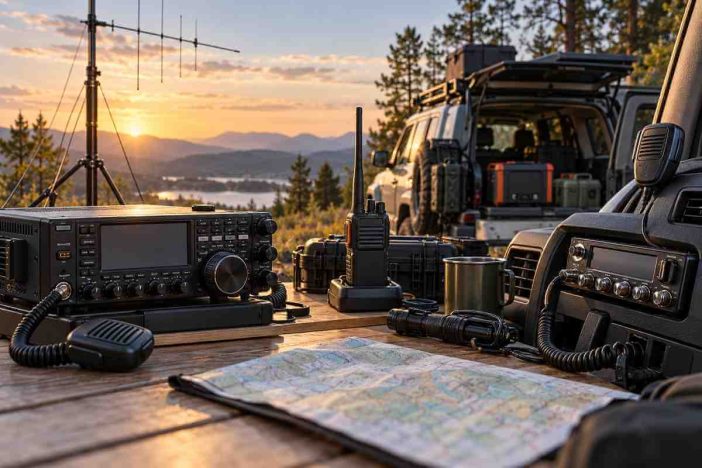
Imagine the cell network has gone down after a severe storm. One family is trying to coordinate between two vehicles. A volunteer radio operator several counties away is checking into an emergency net. Meanwhile, drivers on a nearby highway are sharing road conditions.
All three groups may be using radios, but the radios that work best for them are not necessarily the same.
That is the practical problem behind the ham radio vs GMRS vs CB comparison. These services can all support two-way voice communication without requiring a normal cellular connection for the radio link itself, yet they differ dramatically in licensing, frequencies, equipment flexibility, repeater access, range potential, and the people you can legally communicate with.
The mistake is to choose by advertised mileage alone.
A better method is to ask four questions: Who must communicate? How far apart could they be? What infrastructure can you rely on? How much training and licensing are you willing to accept?
Those questions lead to very different answers for ham radio, GMRS, and CB.
Quick Answer
For most U.S. users:
- Choose GMRS when you need relatively simple family or group communication, especially for vehicles, recreation, property use, or emergency preparedness, and you want access to higher-powered equipment and repeaters without taking an amateur-radio examination.
- Choose CB when you want a license-free radio service with established use around highways, trucking, vehicle communication, and short-range local coordination.
- Choose ham radio when you want the broadest technical capabilities, access to many frequency bands and modes, local repeaters, long-distance communication possibilities, experimentation, or participation in organized amateur emergency communications.
Ham radio requires an amateur operator license before transmitting. GMRS requires an individual FCC license, while eligible immediate family members can operate under that license. CB normally operates under rule-based authorization rather than an individual station license.
No option is universally best. The strongest choice depends on the communication problem you are trying to solve.
Ham Radio vs GMRS vs CB at a Glance
| Factor | Ham Radio | GMRS | CB |
|---|---|---|---|
| Individual license | Required to transmit | Required | No individual license normally required |
| Exam | Yes | No operator examination | No |
| Main strength | Maximum flexibility and technical capability | Practical family/group communications | Simple license-free vehicle/local communication |
| Frequency scope | Many amateur bands | UHF channels around 462/467 MHz | 27 MHz CB channels |
| Repeaters | Extensive amateur repeater ecosystem | Supported | Conventional CB does not use the same repeater model |
| Long-distance potential | Very high with suitable bands, equipment and conditions | Primarily local/regional | Primarily local, with propagation sometimes extending signals much farther |
| Equipment flexibility | Very high | Moderate | Relatively simple |
| Family convenience | Every transmitting operator generally needs appropriate amateur authorization | One individual license can authorize defined immediate family members | Simple for eligible users |
| Emergency value | Excellent when operators are trained and networks exist | Very practical for family/local preparedness | Useful for local and highway communication |
| Learning curve | Highest | Moderate | Lowest to moderate |
This table should be treated as a decision framework, not a mileage guarantee. Terrain, antenna height, frequency, obstructions, propagation, radio installation, repeater availability, and local noise often matter more than the number printed on a product box.
If you are completely new to amateur radio, first read our guide explaining what ham radio is and how it works. It provides the foundation for understanding why amateur radio offers more flexibility than GMRS or CB.
1. Licensing Is the First Major Difference
Licensing is one of the clearest distinctions in the ham radio vs GMRS vs CB decision.
Ham radio requires knowledge as well as authorization
In the United States, a person normally needs an amateur radio operator license before transmitting on amateur frequencies. The current entry path begins with the Technician license, with General and Amateur Extra providing additional privileges.
This is more than administrative paperwork. Amateur licensing is deliberately tied to operating practices, regulations, radio fundamentals, safety, and technical knowledge. Current ARRL materials continue to support Technician, General, and Amateur Extra examination paths.
That additional learning creates friction for someone who simply wants to hand radios to family members for a road trip. But it becomes an advantage for operators who want to understand antennas, propagation, repeaters, digital modes, HF communication, or emergency networks.
GMRS uses a license but no amateur-radio examination
GMRS takes a different approach.
A valid individual GMRS license is required. The individual applicant must meet FCC eligibility requirements, and a GMRS license normally runs for 10 years. More importantly for family communication, the rules allow the license holder’s defined immediate family members to operate GMRS stations under that license.
That makes GMRS unusually practical for a household.
A parent can build a family communication plan without requiring every eligible immediate family member to study for a separate amateur examination.
There is an important limitation, however: a GMRS family license should not be interpreted as a blanket authorization for every friend, coworker, club member, or unrelated person in your group. The FCC specifically defines the family relationships covered by the license. Emergency-message provisions are separate.
CB removes most licensing friction
CB has the lowest entry barrier of the three.
The FCC’s Personal Radio Service rules generally authorize eligible persons to operate services that do not specifically require individual licenses, and CB operates under that framework. Operators still have to comply with CB operating rules; license-free does not mean rule-free.
That simplicity helps explain why CB remains attractive for drivers, temporary vehicle coordination, and people who want basic two-way radio without an examination or individual radio license application.
Decision point: if licensing simplicity matters most, CB is easiest. If a family-friendly licensed service is acceptable, GMRS offers a strong middle ground. If learning and maximum capability matter more than simplicity, ham radio becomes more attractive.
2. The Three Services Use Spectrum Differently
A radio service is not simply a transmitter with a different label. Its frequencies influence antenna size, propagation, equipment design, repeater behavior, and practical range.
Ham radio covers a much larger technical playground
Amateur radio operators have access to numerous authorized frequency bands ranging from HF through VHF, UHF, and microwave allocations, subject to license privileges and applicable rules. ARRL’s current frequency information illustrates how broad that spectrum access can be.
This is one reason asking, “How far does ham radio reach?” has no single meaningful answer.
A VHF handheld working simplex across a city is a completely different system from an HF station communicating hundreds or thousands of miles through ionospheric propagation.
Ham radio can also support numerous analog and digital techniques. That versatility is central to amateur radio rather than an optional extra.
GMRS is focused and predictable
GMRS occupies a much narrower UHF environment.
That limitation is also one of its strengths. Equipment is comparatively straightforward, channelized operation is easier for nontechnical users, and repeaters can extend practical coverage where suitable systems are available.
Current FCC rules allow up to 50 watts transmitter output power for certain GMRS mobile, repeater, and base-station operations on the main channels, while other channels have lower limits. For example, 462 MHz interstitial channels are limited to 5 watts ERP, and 467 MHz interstitial handheld operation is limited to 0.5 watt ERP.
This is why statements such as “GMRS is a 50-watt service” are incomplete. The permitted limit depends on the channel and type of station.
CB occupies a very different radio environment
CB operates around 27 MHz. Its lower frequency means its propagation and antenna behavior differ substantially from UHF GMRS.
Current CB rules limit AM or FM voice carrier power to 4 watts, while SSB voice operation can use up to 12 watts peak envelope power.
Yet transmitter power alone does not tell you which service will communicate farther.
Frequency, antenna efficiency, antenna height, local noise, terrain, installation quality, and propagation can overwhelm simple wattage comparisons.
That leads to the next and often most misunderstood difference.
3. Range Is Mostly a System Problem, Not a Wattage Contest
One of the weakest ways to compare ham radio, GMRS, and CB is to ask only:
“Which has the longest range?”
The technically useful question is:
“Which system can maintain the communication path I need under the conditions where I will actually use it?”
A handheld radio inside a vehicle with a small antenna may perform very differently from a mobile radio connected to a properly installed exterior antenna. A station on elevated terrain may reach farther than a more powerful station surrounded by buildings or hills.
Ham radio has the widest range envelope
Ham radio wins on potential range because amateur privileges span multiple bands and operating methods.
A local VHF or UHF amateur contact may cover only the surrounding area. A repeater located on elevated terrain can dramatically expand that footprint. HF amateur operation, meanwhile, can support communication across regions, countries, and continents when band conditions and equipment are suitable.
ARRL describes amateur radio as capable of communication across town, around the world, and even through space-based amateur systems.
That does not mean every ham handheld will reach hundreds of miles.
The service has high potential because operators can change bands, antennas, modes, infrastructure, and station configurations.
GMRS is strongest when antenna geometry and repeaters work in your favor
GMRS is usually a local or regional communication system.
UHF signals are strongly influenced by terrain, structures, and antenna height. For vehicle convoys, recreation areas, neighborhoods, farms, properties, and family preparedness, this can be exactly what is needed.
A well-positioned GMRS repeater can transform the useful coverage area compared with handheld-to-handheld simplex communication.
But a repeater creates a dependency: if the repeater loses power, becomes overloaded, is inaccessible, or cannot be reached from your location, your communication plan falls back to simplex.
CB can be very useful without making range predictable
CB has long been associated with mobile and highway communication because it provides an open, relatively simple radio service.
At 27 MHz, propagation can also occasionally carry signals far beyond normal local expectations. Those conditions can be fascinating, but they should not be the foundation of a dependable emergency communication plan.
For planning purposes, treat unexpectedly long propagation as a bonus rather than guaranteed coverage.
The practical rule: improve the radio path before chasing watts
When a radio performs poorly, increasing transmitter power is not always the first or best solution.
Often the higher-value improvements are:
better antenna placement, greater antenna height where appropriate, lower-loss feed line, proper antenna tuning, reduced local interference, a clearer path, or access to a suitable repeater.
This applies across all three services, although the exact technical solution differs.
4. Repeaters Change the Ham Radio vs GMRS Equation
Repeaters deserve special attention because they can make a modest handheld radio much more useful.
A repeater receives a signal and retransmits it, usually from a location selected to provide better coverage. Amateur repeaters commonly support wide-area communication from relatively low-powered user stations. ARRL describes repeaters as receiver-transmitter systems that rebroadcast signals and can provide wider coverage even for handheld equipment.
Both ham radio and GMRS can make effective use of repeaters.
CB is different. Conventional U.S. CB operation is built primarily around station-to-station communication rather than the extensive repeater ecosystems familiar to amateur and GMRS users.
Ham repeaters offer capability but require licensed operators
Ham repeaters can be excellent for local and regional communication.
However, everyone transmitting through an amateur repeater needs appropriate amateur authorization. That makes ham radio powerful for trained groups but less convenient when the objective is to distribute radios spontaneously to unlicensed relatives.
GMRS repeaters can be ideal for family networks
GMRS repeaters occupy a useful middle ground.
A household can obtain a GMRS license, equip appropriate family members with compatible radios, and potentially use available repeaters where permitted.
For a prepared family that wants more capability than simple license-free radios but does not want every family member to become a ham operator, this is one of GMRS’s strongest advantages.
Never make a repeater your only plan
Repeaters are infrastructure.
They can be extremely resilient, especially when professionally located and backed by emergency power. But they can still fail.
A robust communication plan should therefore include:
- primary repeater;
- alternate repeater when available;
- simplex channel;
- predetermined meeting locations;
- scheduled check-in times;
- backup power;
- a plan for what to do when nobody responds.
The hardware matters, but the procedure often determines whether the system works under pressure.
5. Who Needs to Talk Is More Important Than Which Radio Looks Best
This is where many buyers choose the wrong service.
Imagine four use cases:
A licensed radio enthusiast wants to talk with other operators across multiple bands.
A family wants radios for two vehicles, camping, and outages.
A group of unrelated coworkers wants day-to-day operational communications.
A highway traveler wants a simple way to hear or exchange nearby road information.
Those are not the same communications problem.
Ham radio is operator-centered
Amateur radio is exceptionally capable, but its operating model assumes licensed radio operators.
That works well for:
- technical hobbyists;
- trained radio clubs;
- volunteer emergency communicators;
- operators experimenting with antennas and propagation;
- people who want local plus long-distance capability;
- users interested in digital modes, satellites, or radio experimentation.
Amateur rules also restrict communications in which the operator has a pecuniary interest, with specific exceptions. Ham radio therefore should not be treated as a substitute for an ordinary business dispatch system.
GMRS is strong for families and practical coordination
GMRS rules explicitly permit two-way plain-language communications concerning personal or business activities, subject to the service’s licensing and operating restrictions. They also give emergency communications priority.
The family-license structure makes GMRS particularly attractive for:
- households;
- family road trips;
- camping groups composed of eligible family members;
- property coordination;
- preparedness plans;
- vehicle-to-vehicle communication.
For business use, pay attention to who is legally authorized to operate each station. An individual’s family license does not automatically turn unrelated employees into covered family operators.
CB is frictionless for casual local communication
CB remains useful when broad accessibility is more important than sophisticated capability.
Its strengths are straightforward:
- no amateur examination;
- no individual CB license application for ordinary eligible users;
- widespread familiarity in vehicle environments;
- simple channel-based operation;
- relatively low barrier to participation.
Its simplicity is part of the feature set, not evidence that it is obsolete.
Radio continues to survive precisely because different systems solve different communication problems. Our broader analysis of why radio is still relevant explains why infrastructure-independent or low-dependency communication still matters in an increasingly connected world.
6. Emergency Communication: Which One Is More Resilient?
Emergency preparedness is where comparisons become especially misleading.
People often ask:
“Is ham radio better than GMRS for emergencies?”
The answer depends on the failure you are preparing for.
If cellular service fails but local repeaters remain operational, both ham and GMRS may provide valuable coverage.
If repeaters also fail, simplex capability, antennas, terrain, operator skill, and distance become more important.
If you need long-distance communication beyond local UHF coverage, suitable amateur HF capability may provide options that GMRS cannot replicate.
If the main objective is keeping several family vehicles coordinated locally, GMRS may be simpler and more realistic than expecting every person to become a skilled amateur operator.
If nobody in the group has obtained a license beforehand, CB can still provide lawful basic two-way capability for eligible operators.
The failure-mode test
Instead of asking which radio is “best for disaster,” test your plan against these four failures:
Failure 1: Cellular network unavailable
Can everyone still communicate directly by radio?
Failure 2: Internet unavailable
Does any essential part of your system depend on an app, cloud directory, or online connection?
Failure 3: Repeater unavailable
Do operators know the simplex fallback channel or frequency?
Failure 4: Grid power unavailable
Can radios, repeaters, and accessories operate from batteries, vehicle power, solar charging, or another backup source?
A system that performs well only when all supporting infrastructure remains healthy is not a complete emergency communication system.
This is why emergency preparedness should combine equipment with operating procedures. See our detailed discussion of the importance of radio in emergencies and our comparison of real-time communication tools for emergency response for the broader resilience context.
Amateur operators also participate in organized emergency communication networks. ARRL notes that amateur operators may support governmental and emergency organizations when conventional telecommunications are damaged or unavailable.
But the strongest emergency radio is still the one your group has licensed where necessary, tested, practiced with, powered, and incorporated into a written plan before the emergency begins.
7. Equipment Cost and Learning Curve Are Very Different
There is no useful single answer to “Which radio is cheapest?” because each service can range from basic equipment to elaborate installations.
The better comparison is the cost of achieving your required communication objective.
CB can have a low complexity cost
A basic CB vehicle installation is conceptually simple:
radio, antenna, mounting, power, and tuning.
The technology still rewards a proper antenna installation, but users do not need to master multiple amateur bands, license classes, repeater offsets, propagation modes, or extensive programming before making ordinary contacts.
That reduces the training cost.
GMRS adds capability without becoming a full technical hobby
GMRS handhelds can be simple, while mobile and base installations can become more sophisticated.
Repeaters, external antennas, mobile radios, feed line, programming, and backup power create room for a more capable system without requiring users to learn the entire amateur-radio ecosystem.
For many families, this balance is exactly the attraction.
Ham radio has the largest capability ceiling
A new ham operator can start with a handheld radio, but amateur radio can expand far beyond it.
Operators may eventually explore:
- VHF/UHF mobile stations;
- repeaters;
- HF transceivers;
- directional antennas;
- digital voice;
- data modes;
- APRS;
- satellites;
- portable field operation;
- propagation analysis;
- emergency nets;
- antenna construction.
That means ham radio can require more learning and eventually more equipment—but it also provides a much larger technical ceiling.
The continuing evolution of these systems is part of the broader future of radio technology, where traditional RF communication increasingly intersects with digital modulation, software-defined systems, network linking, and modern emergency communications.
Which Radio Should You Choose?
The most useful decision can be reduced to the communication mission.
| Your Main Need | Best Starting Point | Why |
|---|---|---|
| Family road trips | GMRS | Simple operation and family licensing structure |
| Family emergency preparedness | GMRS | Good balance of simplicity, repeaters, mobile radios and household use |
| Technical radio hobby | Ham radio | Broadest experimentation and spectrum access |
| Long-distance radio capability | Ham radio | Multiple bands including HF |
| Volunteer emergency communications | Ham radio | Established amateur emergency networks and flexible operating options |
| Highway/trucker communication | CB | Established vehicle use and low entry barrier |
| No exam and no individual license | CB | Simplest regulatory entry of these three |
| Local repeater-based family communication | GMRS | Repeaters plus family-license model |
| Satellites and advanced digital experimentation | Ham radio | Amateur allocations and technical flexibility |
| Temporary communication among eligible casual users | CB | Straightforward channelized operation |
There is also no rule saying a prepared household must choose only one service.
A licensed ham operator may keep amateur equipment for broad capability, GMRS for easy family communication, and CB in a vehicle where nearby CB users are part of the communication environment.
The systems can complement each other.
A Better Way to Choose: The Four-Question Radio Decision Framework
Before purchasing equipment, write down your answers to these questions.
1. Who must be able to transmit?
If every operator is willing to study and become licensed, ham radio becomes much more practical.
If the users are primarily eligible family members and simplicity matters, GMRS has a major advantage.
If you need the lowest participation barrier, CB deserves consideration.
2. What distance actually needs to be covered?
Do not answer “as far as possible.”
Define the real requirement.
Is it:
two vehicles separated by one or two intersections?
family members around a large property?
a neighborhood?
multiple towns?
regional communication?
cross-country amateur contacts?
Different distances may require entirely different radio systems.
3. What infrastructure can fail?
Ask whether your plan assumes availability of:
cell towers,
internet,
commercial electricity,
a local repeater,
a specific mountaintop site,
or an online repeater directory.
Then define a fallback for each dependency.
4. How much complexity can your users tolerate?
The technically superior system is useless if nobody remembers how to operate it.
In an emergency, a radio should not require someone to rediscover:
the correct channel,
repeater offset,
tone,
power setting,
call-sign procedure,
antenna connection,
or backup battery arrangement.
Label radios, create a short operating card, and practice before the system is needed.
Common Mistakes When Comparing Ham Radio, GMRS, and CB
Buying based on advertised range
A package claiming an impressive number of miles does not know whether you will operate inside a city, valley, forest, vehicle, concrete building, or mountaintop.
Real range comes from the complete RF path.
Assuming more watts automatically means much more range
Power matters, but radio propagation does not scale in a simple “double the watts, double the miles” relationship.
Antenna position and radio path can matter far more.
Assuming a repeater will always be available
A repeater is valuable infrastructure, not invulnerable infrastructure.
Always maintain a fallback.
Buying radios before defining the users
Choose the service first, based on who will communicate and under which authorization. Then choose equipment.
Doing this backward often results in radios that cannot legally or practically satisfy the original goal.
Assuming “privacy codes” make conversations private
Two-way radio should generally be treated as an open medium.
Tone-squelch features can help a radio ignore unwanted traffic, but they should not be treated as encryption or as a guarantee that other listeners cannot receive your transmission.
Do not transmit sensitive personal, financial, security, or confidential information simply because the channel sounds quiet.
Treating emergency radio as a piece of equipment instead of a system
An unused radio stored in a drawer is not an emergency communication plan.
A real system includes radios, antennas, power, frequencies or channels, licensing where required, contact procedures, fallback channels, operator practice, and periodic testing.
Ham Radio vs GMRS for Families: Which Makes More Sense?
For many households, GMRS is the more practical starting point because its licensing structure allows defined immediate family members to operate under the individual license holder’s authority.
That reduces one of the main obstacles to deploying radios across a household.
Ham radio becomes more compelling when multiple family members genuinely want to become licensed operators, learn radio technique, participate in amateur networks, or communicate beyond the limitations of a straightforward UHF family system.
There is no reason the two cannot coexist.
A household might use GMRS as its everyday family radio network while one or more members maintain amateur capabilities for broader emergency and technical communication.
GMRS vs CB for Vehicle Communication: Which Is Better?
This decision depends heavily on whom you expect to talk to.
If you are coordinating vehicles within your own licensed family group and have compatible GMRS equipment, GMRS generally provides the more structured private-group workflow, particularly where external antennas, mobile radios, or repeaters are useful.
If your objective includes communicating with nearby CB users—especially in traditional highway and trucking contexts—CB may connect you to the more relevant on-air community.
The question is therefore not simply which radio has better specifications.
It is:
Who is likely to be listening on the other end?
A perfect radio on an empty communication network has limited operational value.
Ham Radio vs CB: Why They Serve Very Different Users
Ham and CB are sometimes compared because both have long histories and both can operate independently of cellular infrastructure.
But their purposes diverge sharply.
CB emphasizes accessible two-way personal radio communication with standardized channels and relatively simple operation.
Ham radio is built around licensed operators, technical development, experimentation, intercommunication, and a much wider set of frequencies and operating modes.
Ham radio can become a lifelong technical discipline.
CB can be a tool you install in a vehicle and use with comparatively little preparation.
Neither characteristic makes one universally superior.
They solve different problems.
Frequently Asked Questions
Is ham radio better than GMRS?
Ham radio offers much greater technical flexibility, more bands, more operating modes, and long-distance possibilities. GMRS is usually easier for practical family communication because it requires no amateur examination and an individual license can authorize defined immediate family members. The better choice depends on the users and required communication distance.
Can GMRS talk to ham radio?
Not as ordinary cross-service communication. GMRS rules prohibit communications with Amateur Radio Service stations except for applicable emergency circumstances specified by regulation. Operators should use each service within its authorized frequencies and rules.
Do you need a license for CB radio?
An individual CB license is generally not required for an eligible user in the United States. CB operation is authorized by rule, but users must still follow applicable Part 95 operating requirements.
Does GMRS require a test?
GMRS requires an individual FCC license, but it does not use the amateur-radio examination structure. Ham radio, by contrast, requires an operator examination before a new operator receives transmitting privileges.
Which radio works when cell towers fail?
Potentially all three.
Ham radio, GMRS, and CB can make direct radio-to-radio contacts without routing the RF conversation through a cellular network. However, practical performance depends on range, terrain, antennas, power, operator skill, frequencies, and whether your chosen operating method relies on a repeater.
Is GMRS better than CB for emergencies?
GMRS often provides useful advantages for a prepared family, including UHF mobile/handheld equipment and repeater capability. CB has the advantage of a lower licensing barrier and an established vehicle-oriented user community.
The best emergency system is the one matched to your actual communication group and tested before a disaster.
Can ham radio communicate worldwide?
Suitable amateur HF stations can make international contacts when propagation, frequency selection, equipment, antennas, and licensing privileges permit. That does not mean every ham radio has worldwide range. A VHF/UHF handheld normally serves a very different communication mission.
Final Verdict: Ham Radio, GMRS, or CB?
The ham radio vs GMRS vs CB decision becomes much easier once you stop asking which radio is “most powerful.”
Choose according to the communication mission.
Ham radio is the strongest choice for people who want technical depth, multiple bands, experimentation, local and long-distance options, organized amateur networks, and room to grow.
GMRS occupies the practical middle ground. It works particularly well for family communication, vehicles, recreation, preparedness, local repeaters, and users who want more capability without an amateur-radio examination.
CB remains valuable when simplicity, accessibility, vehicle communication, and a low entry barrier matter most.
The most resilient solution may even involve more than one.
What matters is not owning the largest collection of radios. It is building a communication system in which the right people can reach one another, know how to operate the equipment, understand the fallback plan, and can continue communicating when the network they normally depend on is no longer available.
That is the point where radio stops being merely another gadget and becomes communications infrastructure you control.