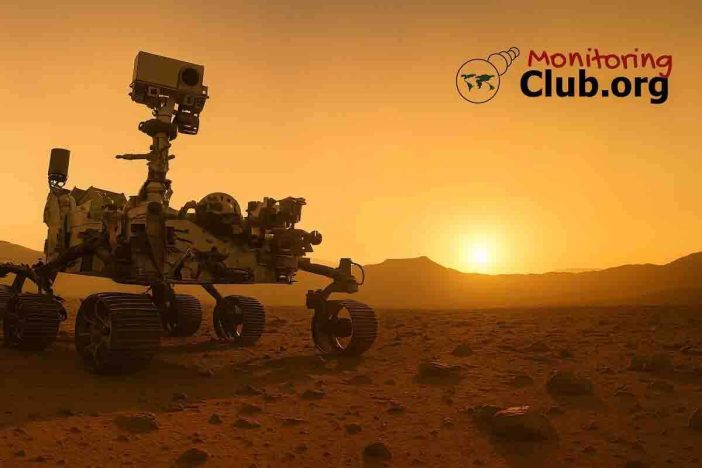
The sun sets on the rust-colored horizon of Jezero Crater, painting Mars in shades of copper and gold. The NASA Mars Rover Perseverance stands still, its metal frame shimmering under a distant sun. A soft whir of machinery breaks the silence as the rover’s robotic arm reaches toward a peculiar rock formation. On its surface are pale, circular patterns—like frozen fossils of forgotten time. Scientists on Earth lean closer to their screens, hearts pounding. Could this be it? Could this be the first whisper of life beyond our world?
This is not just another space headline. This is a story of humanity’s most persistent question—Are we alone? And as NASA Mars Rover Discoveries unfold, they bring us five incredible clues that may finally lead us toward an answer.
NASA Mars Rover Discoveries: 5 Incredible Clues of Life
1. The Leopard-Spotted Rock: A Possible Trace of Life
In July 2024, Perseverance drilled into a rock named “Cheyava Falls” inside the ancient river delta of Jezero Crater. The rock displayed strange, leopard-like spots composed of vivianite and greigite, minerals that, on Earth, are commonly linked to microbial activity in watery environments. NASA scientists labeled it a potential biosignature—a formation that might have originated from ancient Martian life.
The discovery was not declared as proof, but it reignited the hope that microbial life once flourished in the Martian lakes. The spots seemed to tell a story of chemical evolution—iron and sulfur reacting in a once-habitable wet world. As one NASA researcher described, “It’s as if Mars is teasing us with its secrets, giving us just enough to keep looking.”
The sample collected from a rock dubbed “Cheyava Falls” in Jezero Crater is now called “Sapphire Canyon” and has been formally described by NASA as containing potential biosignatures — structures that may reflect ancient microbial activity on Mars. According to the press release published September 10, 2025, these findings represent the “closest we have ever come to discovering life on Mars.” You can read the full NASA statement here: https://www.nasa.gov/news-release/nasa-says-mars-rover-discovered-potential-biosignature-last-year/
2. The Ancient Lake of Jezero Crater
The landing site of Perseverance, Jezero Crater, was not chosen by chance. Billions of years ago, it was a massive lake fed by a flowing river. Layers of clay and carbonate minerals beneath its floor now act like pages of a planetary diary. Each layer records the rise and fall of Martian water—evidence that liquid water once persisted on the surface for millions of years.
Radar data from the rover confirmed sedimentary structures identical to river deltas on Earth. Such calm, mineral-rich waters could have been an oasis for microbial life. Scientists describe Jezero as “the cradle that could have nurtured life”—a geochemical haven where energy, nutrients, and stability once converged.
3. Organic Molecules Hidden in Martian Soil
Perseverance’s SHERLOC spectrometer detected organic molecules—complex carbon-based compounds—in multiple drilled samples. These compounds, which form the foundation of life on Earth, were found embedded in Martian rock layers over 3.5 billion years old.
What makes this finding extraordinary is not the presence of carbon itself, but its structure. The molecules resemble degraded biological material, similar to those found in ancient Earth sediments. Even if they were formed abiotically, their complexity hints that Mars had all the chemical ingredients necessary for life to begin.
Each detection strengthens the idea that Mars was once chemically alive—if not biologically, then at least geologically primed for it.
4. The Dance of the Dust Devils
In 2025, Perseverance captured astonishing high-definition footage of dust devils—massive vertical whirlwinds spiraling across the Martian plains. Though they appear like simple weather curiosities, these swirling columns reveal much about how organic particles might survive or degrade on Mars.
Dust devils mix and redistribute surface materials, sometimes uncovering fresh layers and other times burying delicate organic traces. They help scientists understand the planet’s active climate and how it could protect or destroy the remnants of ancient life. In a poetic twist, Mars itself may be preserving its past with every swirl of dust—a slow dance between erosion and memory.
5. Fossilized Lakebeds and the Stromatolite Mystery
In another corner of Jezero Crater, Perseverance found layered rocks resembling stromatolites—structures created by microbial colonies on ancient Earth. The similarities are striking: thin, wavy laminations of carbonate and clay that once formed in shallow waters. If verified, these fossil-like patterns could be Mars’s first geological confession—a silent admission that life once pulsed beneath its surface.
These fossilized lakebeds are more than just formations. They represent a possible timeline where Mars transitioned from a warm, wet planet to the barren desert we see today. Beneath those layered stones could lie the preserved microtextures of a living world long gone.
What These Five Clues Tell Us
Each clue, by itself, stops short of proving life. Together, however, they weave a compelling narrative. The NASA Mars Rover Discoveries paint Mars not as a dead planet, but as one that lived a complex chemical youth—wet, dynamic, and capable of nurturing biology.
The “leopard-spotted” rocks show chemical fingerprints of metabolism. The ancient lakebed reveals that water was once abundant. The organic molecules tell us that the essential ingredients were already present. Dust devils keep the surface alive, moving and preserving clues. And the stromatolite-like formations whisper of organized life once thriving under the Martian sun.
To continue exploring the next phase of space exploration, read our in-depth report on Crewed Mars Mission Plans, which outlines the technologies, timelines, and breakthroughs paving the way for humans to set foot on Mars. This article connects naturally with the rover discoveries, offering readers a broader perspective on how robotic exploration leads to human colonization.
Why It Matters for Humanity
For centuries, we’ve gazed at Mars as a distant red dot. Now, thanks to Perseverance and NASA’s tireless exploration, that dot feels closer—almost familiar. These incredible clues of life do more than satisfy scientific curiosity; they redefine our understanding of existence itself. If life could arise on Mars, it could arise elsewhere—perhaps even countless times across the universe.
As NASA prepares the Mars Sample Return Mission, set to bring Martian rocks back to Earth within the next decade, scientists are preparing for what could be humanity’s most profound discovery. The answer to “Are we alone?” might already be sealed inside a titanium sample tube, waiting for the day it returns home.
Final Thoughts
Each discovery on Mars is a mirror—reflecting not just the planet’s past, but our endless human drive to explore, question, and dream. The story of NASA Mars Rover Discoveries is a testament to our collective curiosity. It reminds us that exploration is not about finding answers; it’s about expanding the horizon of what’s possible.
When Perseverance drilled into that spotted rock, it didn’t just uncover minerals—it uncovered hope. And sometimes, in science as in life, hope is the most powerful discovery of all.