Why Communication Failures Should Never Be “Closed” Quickly
After an incident subsides, organizations often face pressure to return to normal operations. However, closing an incident before examining communication decisions can leave important weaknesses unresolved.
Conflicting statements, delayed updates, unclear approval authority, and inconsistent escalation procedures may indicate gaps in governance or operational execution. These weaknesses deserve examination even when the immediate incident has been resolved.
A structured post-incident communication review helps reconstruct what happened, distinguish contributing factors from underlying causes, and identify corrective actions. Its purpose is to reduce the risk of similar failures, not to guarantee that future incidents can be eliminated.
What Is a Post-Incident Communication Review?
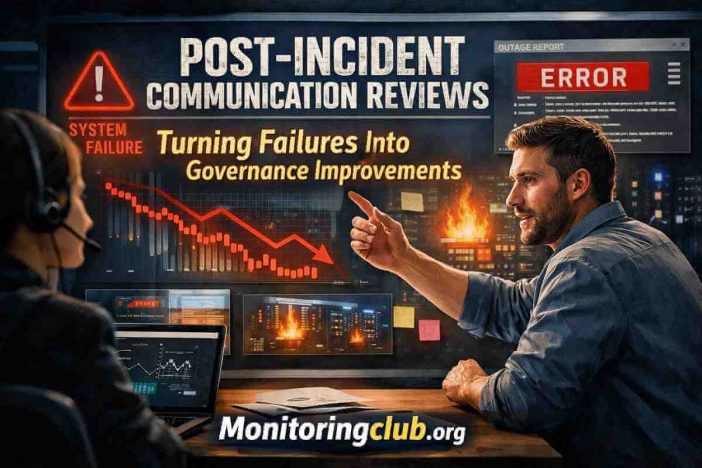
A post-incident communication review is a formal, governance-driven examination of how communication decisions were made, executed, and documented during an incident.
It focuses on:
- decision authority
- message timing and consistency
- escalation paths
- compliance constraints
- accountability evidence.
Within the Governance, Risk & Compliance for Communications authority hub, post-incident reviews function as a structured governance improvement mechanism rather than a reputational exercise.
How Incident Reviews Reveal Governance Weaknesses
Policies and simulations predict risk. Incidents reveal reality.
A structured review can reveal:
- where authority was unclear,
- which approvals slowed response,
- how compliance constraints shaped messaging,
- whether accountability can be proven afterward.
This feedback loop is essential to the Communication Governance Framework: Risk, Compliance, and Accountability, where governance evolves through documented learning.
Post-Incident Reviews vs Crisis Debriefs
Debriefs Focus on Performance
Debriefs often ask:
- What went wrong?
- Who responded?
- What should we do differently?
They are useful—but incomplete.
Reviews Focus on Governance
Post-incident communication reviews ask:
- Who had authority at each stage?
- Was that authority documented?
- Were governance rules followed or bypassed?
- Can decisions be defended under scrutiny?
The difference determines whether improvement is cosmetic or structural.
How Post-Incident Reviews Strengthen Accountability
Accountability requires proof, not explanation.
As demonstrated in Communication Audit Trails: How Accountability Is Proven, Not Claimed, reviews rely on audit trails to reconstruct:
- decision sequences,
- approvals and overrides,
- message versions and distribution.
Without audit trails, reviews become narrative. With them, accountability becomes evidence-based.
Key Governance Questions Every Review Must Answer
Was Authority Clear and Respected?
Reviews must verify whether predefined authority models—such as those outlined in Who Has Authority to Communicate During a Crisis? Governance Decision Models Explained—were followed or ignored.
Did Compliance Shape Decisions or Obstruct Them?
Post-incident reviews examine whether compliance requirements were:
- embedded into systems, or
- applied manually under pressure.
This distinction reflects the maturity described in Compliance by Design in Communication Infrastructure.
Can Decisions Be Defended After the Fact?
If decisions cannot be reconstructed and justified later, governance has failed—regardless of outcome.
From Failure to Framework: Turning Findings Into Governance Improvements
A post-incident review is only valuable if its findings change systems.
Effective institutions:
- update authority matrices,
- refine escalation thresholds,
- improve audit trail design,
- revise communication risk registers and reassess exposure scenarios outlined in Risk Management in Communication Systems,
- test changes through simulations.
This is how failure becomes institutional memory.
Expert Insight: Learning Is a Governance Obligation
Expert Insight
Organizations can strengthen communication governance by integrating post-incident reviews into established oversight and risk management processes. Effective reviews should identify underlying weaknesses, assign corrective actions, establish clear ownership, and verify whether improvements work in practice. Their value depends not only on documented procedures but also on leadership commitment, organizational culture, and consistent follow-through. A completed review does not automatically demonstrate that communication risks have been adequately addressed.
Practical Checklist: Conducting an Effective Post-Incident Communication Review
A post-incident communication review should produce more than a meeting summary. Its practical value comes from reconstructing decisions, identifying control failures, and assigning corrective actions that can be independently verified.
Seven Steps for an Evidence-Based Review
- Define the review scope. Record the incident, affected communication channels, key stakeholders, review period, and accountable review owner.
- Preserve relevant evidence. Collect approved message versions, communication logs, timestamps, escalation records, and authorization decisions in accordance with applicable retention and privacy requirements.
- Reconstruct the communication timeline. Establish when information became available, who received it, when decisions were approved, and when messages reached their intended audiences.
- Identify governance gaps. Examine unclear decision authority, missing approvals, inconsistent information, and escalation procedures that failed under operational pressure.
- Distinguish causes from symptoms. A delayed announcement may be a symptom. The underlying cause could be an unavailable approver, an incomplete escalation matrix, or a communication channel without backup arrangements.
- Assign corrective actions. Each confirmed finding should have an accountable owner, a defined action, a target completion date, and supporting evidence requirements.
- Verify effectiveness. Confirm implementation through documented review, a suitable exercise, or another appropriate control test. Close findings only when the acceptance criteria have been met.
Example: Turning a Communication Failure Into Corrective Action
Consider a hypothetical organization that issued conflicting incident updates because two departments believed they had final approval authority.
- Finding: Communication approval responsibilities overlapped during an incident.
- Evidence: Conflicting message versions, approval records, and timestamps.
- Root cause: No documented authority hierarchy for emergency messaging.
- Corrective action: Establish a primary approval owner, delegated backup, and escalation deadline.
- Accountable owner: The designated communication governance lead.
- Verification: Conduct a tabletop exercise demonstrating that the revised approval process produces one authorized message.
This is an illustrative scenario, not a claim about a documented incident.
How to Measure Whether the Review Worked
Organizations can evaluate review effectiveness using measurable indicators such as:
- Percentage of corrective actions completed and verified by their target dates.
- Number of unresolved communication governance findings.
- Frequency of repeated findings across subsequent incidents or exercises.
- Time required to identify the authorized decision-maker during an escalation test.
- Completeness of communication audit trails and approval evidence.
These measures demonstrate whether corrective processes are being implemented and tested. They do not, by themselves, prove that post-incident reviews prevent future incidents.
Related Accountability Evidence:
Post-incident reviews depend on structured documentation generated through communication audit trails.
→ Communication Audit Trails: How Accountability Is Proven, Not Claimed
Related Governance Reinforcement
Post-incident reviews frequently expose structural gaps in governance–compliance alignment and highlight weaknesses in documented communication risk registers.
→ Governance vs Compliance in Communication Systems: What Institutions Often Get Wrong
→ Communication Risk Register Explained: How Institutions Identify and Track Messaging Risks
FAQ – People Also Ask
What is a post-incident communication review?
It is a structured governance review that analyzes communication decisions after an incident to improve authority, compliance, and accountability.
When should post-incident reviews be conducted?
Reviews should begin after immediate operational risks are stabilized, while communication records, decision timelines, and supporting evidence remain available. The exact timing depends on incident severity, organizational procedures, and applicable requirements.
Are post-incident reviews about assigning blame?
The primary purpose is to understand communication failures, identify governance weaknesses, and improve organizational controls. Potential misconduct or individual accountability issues may require a separate, appropriate investigation.
How do reviews improve future crisis response?
By clarifying authority, embedding compliance, and strengthening auditability before the next incident.
Wrapping Up: Governance Improves Only When Failures Are Studied
Post-incident communication reviews are most useful when findings lead to changes that can be documented, implemented, and tested. A completed review should identify what went wrong, why it happened, who is responsible for corrective action, and how improvements will be verified.
Clear decision authority, traceable approvals, effective escalation procedures, and documented accountability can help organizations address recurring communication weaknesses. However, their effectiveness must be assessed through subsequent exercises, incident evidence, and ongoing control monitoring.
The ultimate measure of a successful review is not the number of findings recorded. It is whether the organization can demonstrate meaningful improvements in communication governance, risk management, and operational accountability.
Reference
The following authoritative publications provide supporting context for incident response, crisis communication governance, and organizational improvement.
-
National Institute of Standards and Technology (NIST). (2025).
Incident Response Recommendations and Considerations for Cybersecurity Risk Management: A CSF 2.0 Community Profile.
NIST Special Publication 800-61, Revision 3.
Official NIST publication.
This guidance addresses cybersecurity incident response and the integration of response improvements into risk management. Its scope is cybersecurity, rather than all forms of organizational communication incidents.
- International Organization for Standardization (ISO). (2022). ISO 22361:2022 — Security and resilience: Crisis management — Guidelines. Official ISO standard overview.
- International Organization for Standardization (ISO). (2019). ISO 22301:2019 — Security and resilience: Business continuity management systems — Requirements. Official ISO standard overview.
Editorial note: These references provide relevant principles and frameworks. The practical review checklist and hypothetical example in this article are editorial applications, not verbatim procedures prescribed by these publications. References to ISO standards do not imply that MonitoringClub.org or any organization discussed is ISO-certified.
This article follows MonitoringClub.org’s Editorial Policy and is reviewed under the Content Review & Verification Policy.